The industrial world is experiencing a fundamental shift in how physical goods are designed, assembled, and delivered. For more than a century, industrial manufacturing depended on rigid, high-volume production lines optimized for standard goods. These traditional setups yielded significant economies of scale, but they lacked the agility needed to handle fluctuating consumer demand, rapid technological cycles, and widespread supply chain disruptions.
Today, advanced production architectures are replacing those rigid workflows. Modern production systems combine smart physical machinery, advanced computational networks, and adaptive operational frameworks. This integration allows industrial facilities to pivot between customized product variations instantly, eliminate structural waste, and maintain continuous visibility across complex supply chains. The result is a manufacturing paradigm that prioritizes flexibility, speed, and precision without sacrificing profitability.
The Structural Evolution of Industrial Manufacturing
To understand modern manufacturing, one must examine how production models evolved to address operational bottlenecks. Industrial progress is defined by the transition from disconnected mechanical workflows to unified, data-driven production ecosystems.
-
Dedicated Legacy Assembly Lines: Early mass production relied on fixed tooling and sequential mechanical assembly. While highly efficient for identical products, retooling these systems for model updates required weeks of costly factory downtime.
-
Flexible Manufacturing Cells: The introduction of programmable logic controllers allowed facilities to group machinery into cells capable of handling product families. However, communication between disparate vendor systems remained fragmented.
-
Cyber-Physical Production Systems: Modern production unifies shop-floor machinery, automated logistics, enterprise software, and cloud analytics into a single responsive network. Machines configure their own parameters based on digital product blueprints traveling with each unit.
Modular Factory Design and Reconfigurable Manufacturing
The defining trait of modern production systems is physical modularity. Instead of anchoring machinery permanently into concrete floors along a linear conveyor, modern facilities utilize modular production cells that can be expanded, relocated, or reconfigured within hours.
-
Decoupled Workstations: Independent production pods execute specialized fabrication steps, allowing parts to bypass congested stations or take alternate routes through the plant based on tool availability.
-
Autonomous In-Plant Logistics: Autonomous mobile robots and automated guided vehicles transport raw materials, fixtures, and sub-assemblies between decoupled cells, eliminating fixed overhead conveyor systems.
-
Plug-and-Produce Machinery: Standardized electrical, pneumatic, and digital communication interfaces allow new production modules to integrate into existing lines with minimal engineering friction.
The Convergence of Additive and Subtractive Fabrication
Modern industrial production is moving away from the historic divide between additive manufacturing and subtractive computer numerical control milling. Contemporary facilities merge both disciplines into hybrid production cells that capture the benefits of each method.
-
Complex Geometry Generation: Industrial three-dimensional printing builds consolidated components featuring internal cooling channels, lattice structures, and organic topologies that are impossible to machine through traditional tooling.
-
Precision Surface Finishing: After additive systems build the near-net-shape part, high-precision subtractive multi-axis mills machine critical sealing faces, bearing journals, and threaded connections to microscopic tolerances.
-
Rapid Tooling and Fixture Creation: Plant technicians print specialized end-of-arm tooling, inspection jigs, and assembly nests on demand using technical polymers or metal powders, cutting tooling lead times from months to days.
Data Integration and the Digital Thread
A modern production system operates on a continuous stream of structured data known as the digital thread. This digital pipeline connects the original computer-aided design model to simulations, fabrication processes, quality inspections, and real-world field telematics.
-
Bidirectional Design Feedback: Dimensional inspection data captured on the shop floor feeds directly back to engineering design models, allowing computational tools to update tolerances automatically based on real-world machining performance.
-
Closed-Loop Quality Control: In-line optical scanners and tactile probes inspect parts during active production runs. If a feature drifts near the edge of acceptable tolerance, the system sends automated offset adjustments to the upstream machine tool before defects occur.
-
Complete Genealogy Tracking: Every manufactured part is linked to a permanent digital record that documents its specific raw material batch, machine operator, thermal history, tool wear metrics, and environmental conditions at the moment of fabrication.
Human-Machine Collaboration in Modern Facilities
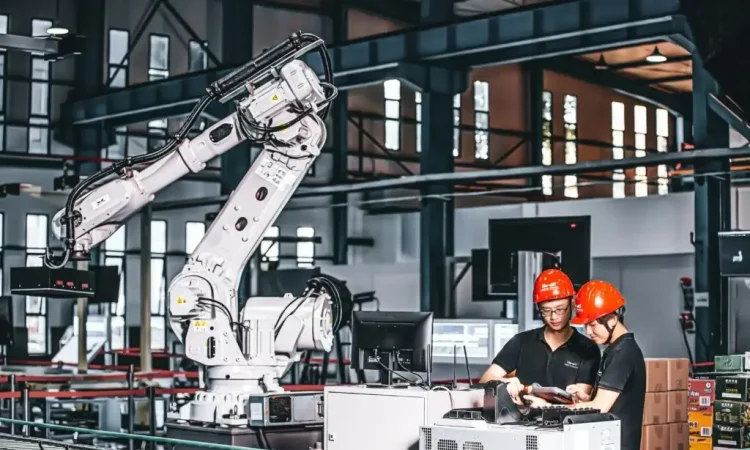
Contrary to early assumptions that modern production would eliminate human labor entirely, advanced industrial systems focus on human augmentation. Technology handles repetitive, dangerous, and high-strain tasks, allowing skilled human operators to focus on problem solving, process optimization, and complex assembly tasks.
-
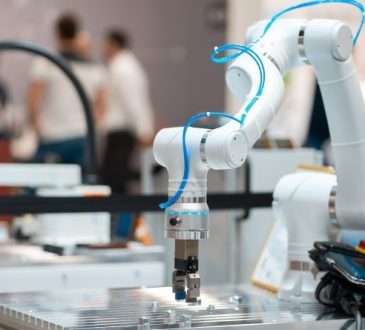
Collaborative Robotics: Lightweight cobots equipped with integrated vision systems and force-torque sensors assist workers with delicate assemblies, heavy lifting, and adhesive dispensing without requiring safety cages.
-
Heads-Up Digital Guidance: Wearable augmented reality devices and projected optical work instructions guide assembly operators step by step through complex custom configurations, drastically reducing human error and accelerating training.
-
Ergonomic Safety Monitoring: Wearable bio-sensors and workstation video analytics assess operator posture and physical strain, alerting plant safety leads to ergonomically risky workstations so tasks can be redesigned proactively.
Sustainable Resource Management and Circular Flows
Modern production systems integrate resource efficiency directly into standard operational procedures. Tight environmental regulations, expensive raw material inputs, and high industrial energy tariffs require modern facilities to monitor and minimize waste systematically.
-
Material Scrappage Reduction: Advanced nesting algorithms and generative software optimize the cutting of metals, carbon fiber sheets, and specialty plastics, maximizing raw material utilization.
-
Dynamic Energy Modulation: Intelligent plant management platforms balance electrical loads, shutting down non-essential pumps, blowers, and heater banks when machines enter idle or changeover states.
-
Closed-Loop Coolant and Lubricant Recovery: Advanced separation centrifuges and continuous filtration systems treat, balance, and recirculate metalworking fluids and industrial washing agents, reducing waste disposal fees.
Resilient and Distributed Production Architectures
Modern production systems are reshaping the geographic landscape of industrial manufacturing. Instead of relying entirely on massive, centralized mega-factories located across the world, organizations are deploying distributed networks of agile, localized production hubs.
-
Localized On-Demand Assembly: Agile micro-factories positioned near major consumer markets assemble finished products from standardized components, lowering international shipping transit times and tariff exposures.
-
Resilient Capacity Routing: Connected enterprise platforms shift production orders across regional facilities dynamically based on real-time plant utilization, regional energy pricing, and supply availability.
-
Virtual Inventory Systems: Rather than maintaining massive warehouses filled with slow-moving spare parts, organizations store validated digital engineering files, printing or machining replacement components locally only when a customer places an order.
Frequently Asked Questions
What is the practical difference between flexible manufacturing systems and reconfigurable manufacturing systems?
Flexible manufacturing systems are designed with built-in generalized capabilities to handle a predefined variety of known product variations. Reconfigurable manufacturing systems are engineered with modular hardware and software components that can be physically reorganized and reprogrammed rapidly to adapt to entirely unexpected product designs and shifting market demands.
How do modern production systems handle legacy machinery that cannot communicate natively?
Facilities modernize legacy assets by retrofitting them with non-invasive external sensors, optical encoders, and localized industrial edge gateways. These edge devices capture mechanical vibrations, current draws, and physical movements, converting raw signals into modern standard protocols without modifying internal machine controllers.
What role does open architecture software play in modern production environments?
Open architecture software prevents industrial facilities from being locked into single hardware vendors. By utilizing non-proprietary communication frameworks and standardized application programming interfaces, manufacturers can connect distinct machines, robotics, and enterprise software platforms into a unified operational ecosystem.
How does mass customization affect supply chain complexity in modern facilities?
Mass customization increases the variety of incoming sub-components while decreasing predictable batch sizes. Modern facilities manage this complexity through automated warehouse storage systems, dynamic kitting carts guided by optical trackers, and real-time electronic inventory management that synchronizes parts delivery with specific assembly jobs.
What is the impact of additive manufacturing on industrial spare parts warehousing?
Additive manufacturing enables digital warehousing, where physical spare parts inventories are replaced by verified computer-aided design files. When an obsolete or specialized replacement component is needed, the file is retrieved and fabricated locally on an industrial three-dimensional printer, eliminating warehouse holding costs and supply chain delays.
How do modern factories address the cybersecurity risks associated with connected industrial machinery?
Modern plants secure operational technology by implementing zero-trust network architectures, establishing strict physical and digital segmentation between corporate networks and machine control networks, deploying continuous anomaly-detection monitoring, and isolating emergency safety shutdown systems on dedicated hardwired circuits.
What is meant by synchronous flow in modern multi-product assembly lines?
Synchronous flow is an operational strategy where disparate components and sub-assemblies arrive at the primary assembly station at the exact moment they are needed for a specific custom unit. This eliminates work-in-progress clutter, reduces staging space requirements, and ensures continuous production movement without line stoppages.