Traditional distribution networks have long treated square footage as an insurance policy against supply chain uncertainty. Pallets sit in multi-tier racking for weeks or months, generating carrying costs, tying up operational capital, and requiring repetitive labor for put-away, storage replenishment, and retrieval. As commercial real estate leasing rates and industrial utility costs continue to rise, maintaining massive static inventory footprints places a direct strain on operating margins.
Cross-docking fundamentally alters this balance sheet dynamic by shifting the operational focus from storage to pure inventory velocity. Rather than directing inbound freight into deep racking, products are unloaded from inbound trailers, sorted and consolidated across an open staging floor, and loaded directly onto outbound trailers with minimal or zero intermediate holding time.
Executing this transition requires more than clearing floor space near your loading bays. It demands a deliberate operational transformation that synchronizes inbound logistics, facility ergonomics, vendor compliance, and warehouse management software.
Screening SKU Profiles for Cross-Dock Viability
The most common operational mistake organizations make when launching a cross-docking initiative is attempting to route their entire product catalog through the same rapid-turn workflow. Cross-docking is not a universal replacement for inventory storage; it is a high-velocity lane designed for specific demand patterns. Attempting to force erratic, low-velocity SKUs through a cross-dock environment clogs the staging floor with orphaned freight that eventually has to be moved back into storage anyway.
Ideal candidates for cross-docking generally fall into three operational categories:
First are pre-allocated retail orders and backorders. When customer demand is already confirmed and attributed to a specific retail store, distribution center, or customer account before the goods leave the supplier, storage serves no business purpose. Unloading a container only to place it in high-bay racking for three days before picking it for an outbound truck represents pure labor waste.
Second are high-velocity staple goods with predictable run rates. Fast-moving consumer goods, high-turnover grocery items, and standardized industrial supplies with consistent daily consumption rates can bypass storage entirely. Inbound shipments can be staged directly against daily outbound truck schedules without building buffer stock.
Third are perishable or time-sensitive inventory lines. Temperature-controlled foods, fresh produce, and pharmaceuticals with restricted shelf lives benefit from immediate transfer. Removing the intermediate storage step preserves valuable product life and reduces spoilage risk.
Re-Engineering Dock Ergonomics and Terminal Layout
A warehouse designed for static storage features deep aisle configurations, narrow pathways optimized for reach trucks, and modest dock aprons. In contrast, a cross-dock facility is an exchange hub where physical throughput dictates floor layout.
Footprint Geometry and Traffic Flow
Most purpose-built cross-dock terminals utilize an elongated I-shaped building profile. Inbound trailers dock along one long wall of the facility, while outbound trailers align along the opposing wall. The central floor space between the doors acts as a staging, sorting, and inspection lane. This linear layout ensures the shortest physical travel distance between receiving and shipping doors, minimizing the transit time for forklifts, tuggers, and pallet jacks.
For existing facilities that cannot undergo structural reconfiguration, dedicated “U-shaped” cross-dock zones can be established within a corner of the building. In this setup, inbound and outbound doors sit adjacent to one another, sharing a common staging floor. While this design requires strict traffic management to avoid forklift cross-traffic, it allows existing operations to test cross-docking without costly real estate expansion.
Staging Lane Allocation
Congestion on the dock floor is the primary operational risk in any cross-docking initiative. To maintain fluid movement:
-
Establish dedicated outbound lanes. Floor space directly behind each outbound door should be clearly gridded and labeled for specific delivery routes, carrier accounts, or regional hubs.
-
Enforce dwell-time limits. Establish a strict policy that no pallet may remain in a cross-dock staging lane for longer than 12 to 24 hours. Any pallet exceeding that threshold must be either loaded immediately or cleared to designated buffer storage to prevent dock gridlock.
-
Incorporate mechanized sortation. For carton-level cross-docking, automated conveyor belts equipped with multidirectional sorters can divert incoming packages straight from an inbound trailer into designated outbound truck chutes without manual palletizing.
Upgrading the Digital Nervous System
Cross-docking is an information-driven discipline. Physical goods can only move as fast as the data that precedes them. If a receiving crew does not know what is inside an inbound trailer until the doors open, they cannot pre-assign destination staging lanes, and the shipment stalls.
The technological baseline starts with the Advanced Shipping Notice (ASN) transmitted via Electronic Data Interchange (EDI 856) or modern API integrations. The ASN provides itemized visibility into inbound cargo down to the carton serial number and pallet License Plate Number (LPN) hours or days before the truck arrives at the yard.
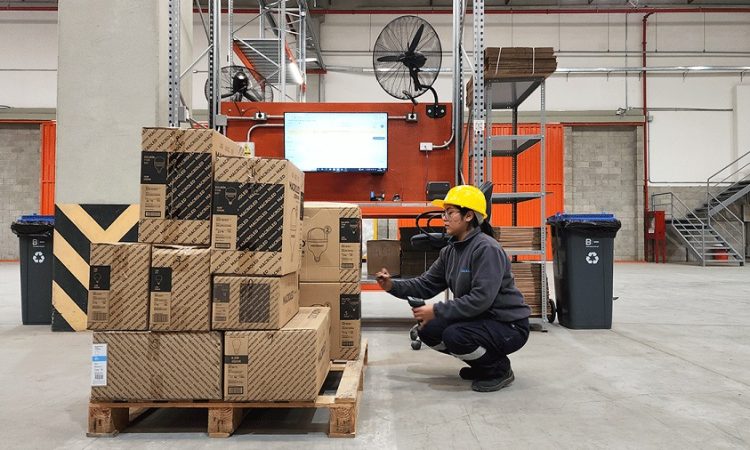
When the inbound shipment arrives, receiving staff scan the pallet LPN using handheld mobile terminals or automated gate-mounted RFID scanners. A modern Warehouse Management System (WMS) or Warehouse Execution System (WES) instantly cross-references the scanned LPN against active outbound orders. Instead of prompting the operator to transport the pallet to an aisle and rack location, the WMS directs the operator to transport the pallet directly to Outbound Door 14, Staging Lane B.
This real-time task interleaving eliminates two full cycles of material handling: the put-away cycle and the retrieval picking cycle.
Enforcing Strict Vendor and Carrier Discipline
A cross-dock terminal operates on precise scheduling. When inbound trailers arrive unannounced, show up hours late, or carry freight with illegible barcodes, the entire cross-dock workflow breaks down.
To protect dock throughput, organizations must institute rigorous vendor compliance programs:
-
Standardized labeling and packaging. Suppliers must apply standardized shipping container labels, such as GS1-128 barcodes, with absolute placement accuracy. If an automated scanner cannot read a pallet tag due to crushed cartons or wrinkled plastic wrap, manual exception handling slows down the entire line.
-
Strict dock appointment scheduling. Move away from open receiving windows and implement yard management software with designated 30-minute appointment slots. Unscheduled trucks should be directed to overflow parking until a scheduled window opens.
-
Tiered compliance chargebacks. Establish clear contractual service-level agreements with suppliers. Missing ASNs, late deliveries, incorrect pallet tie-high configurations, or damaged barcodes should incur documented administrative fees to offset the operational labor required to fix the discrepancy.
Executing a Phased Rollout
Transitioning to cross-docking does not require an abrupt operational overhaul. The lowest-risk adoption model begins with opportunistic cross-docking. In this phase, your WMS continues running standard warehouse operations but checks inbound receipts against outstanding backorders. If an open customer order matches an inbound delivery, the software intercepts the pallet at the receiving dock and routes it straight to packing or shipping, bypassing the racks.
Once cross-dock workflows, scanning protocols, and dock crew rhythms are established through opportunistic intercepts, operations can progress to planned consolidation cross-docking. In this model, multiple small Less-Than-Truckload (LTL) shipments from various vendors are systematically merged on the dock into consolidated full truckload (FTL) deliveries for regional hubs.
By removing the reliance on stationary storage, enterprises can handle significantly higher cargo volumes without expanding their physical footprint. Cross-docking transforms the warehouse from an expensive holding tank for working capital into a dynamic, fast-flowing transfer hub that dramatically lowers carrying costs and accelerates fulfillment cycles.